Guide · 4 designs
Native American Face and Chin Tattoo Meaning: A Tradition That Belongs to Its People
Among many Indigenous nations of North America, face and especially chin tattoos were marks of identity, adulthood and belonging - most often worn by women. Arctic peoples (Inuit, Iñupiat, Yup'ik) and nations of northern California such as the Yurok, Hupa and Karuk are known for vertical chin lines. These tattoos are being revived by members of those nations today, and they are not designs for outsiders to copy.
IWhat the lines meant
Details differ from nation to nation, and the people who carry these traditions are the ones to explain them fully. In broad terms, a girl received chin lines around the time she became a woman. The lines said who she was and where she came from; for some families they also showed beauty and readiness for adult life.
Among Arctic women, lines on the chin and face were made by hand-poking or by sewing soot-darkened thread through the skin. Among the Yurok and their neighbours, three vertical lines on the chin - often called the "111" - were the traditional form.
Missionaries and government schools pressured families to abandon the practice, and for decades it nearly disappeared. In recent years many women have taken it back, often in ceremonies with family present, sometimes as the first in their family for several generations.
IIWhy this is not a design to borrow
A chin tattoo from these traditions is not a style; it is a statement of membership in a specific people. Wearing one without that connection is widely seen as taking something that was suppressed for generations and is only now being returned to its owners. The same goes for war bonnets (feather headdresses), which in many nations are earned honours.
If what draws you is respect for these cultures, the most respectful choice is to support Indigenous artists and to choose a design that speaks to your own story.
IIINature motifs worn off the face
Many people who admire Indigenous art choose animals and natural forms that are shared across cultures. These are general designs, not tribal marks.
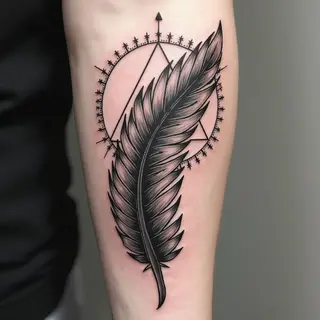 AI-generated
tribalEagle Feathers Tattoo Meaning in Native American CultureA detailed feather inside a geometric frame on the forearm.
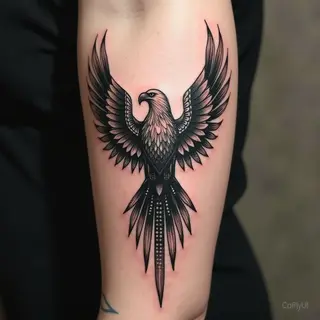 AI-generated
illustrative · armUnderstanding the Symbolism of Native American Eagle TattoosAn eagle with spread wings in black, bold enough to age well.
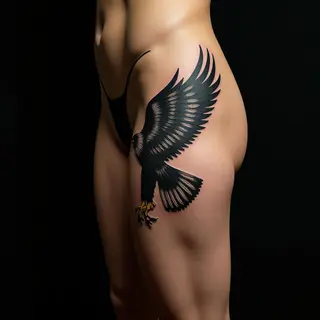 AI-generated
oriental · thighNative American Headdress Thigh Tattoo: Symbolism & MeaningA small eagle in flight on the side of the thigh.
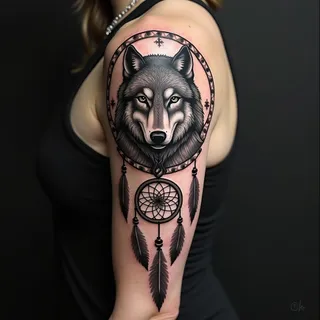 AI-generated
illustrativeNative American Indian Tattoo Ideas: Meanings & InspirationA wolf above a dreamcatcher - the dreamcatcher itself comes from Ojibwe tradition, so treat it with care.
IVQuestions people ask
What do three lines on the chin mean?
In several northern California nations, such as the Yurok, three vertical chin lines are a traditional women's tattoo marking adulthood and identity. Outside that context, three lines have no single meaning.
Can a non-Native person get a chin tattoo?
Anyone can get lines on their chin, but copying a traditional Indigenous chin tattoo is widely seen as disrespectful. If it is Indigenous heritage that draws you, talk to people from that nation first.
Are traditional chin tattoos still done today?
Yes. Since the early 2000s many Indigenous women in Alaska, Canada and California have revived them, often with traditional techniques.