Guide · 25 designs
Polynesian Tattoo Meanings and Symbols: Reading the Patterns With Respect
Polynesian tattoos are built from a vocabulary of motifs - shark teeth for protection and strength, waves for life and change, the turtle for long life and family, spearheads for courage, small human figures for people and ancestors. In the islands where it comes from, a full traditional tattoo also records a person's family, rank and life, so the meaning belongs to the wearer as much as to the symbols.
IWhere the word tattoo comes from
When James Cook's expedition reached Tahiti in 1769, the crew wrote down the word tatau for the marks they saw on islanders' skin. It became "tattoo" in English. The practice is much older than that encounter and is still very much alive across Samoa, Tonga, the Marquesas, Tahiti, Hawai'i and Aotearoa New Zealand - each with its own style and rules.
Two things are worth knowing before you choose a design. First, traditional pieces were and are earned: the Samoan pe'a for men, from waist to knees, and the malu for women, on the thighs, are rites of passage applied by hand by a master tattooist. Second, most designs in this guide are Polynesian-inspired tattoos made for people outside those families. That is common and accepted by many artists, but it is a different thing from the tradition itself.
IIShoulders and sleeves: the classic placement
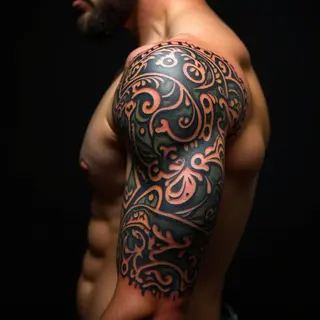
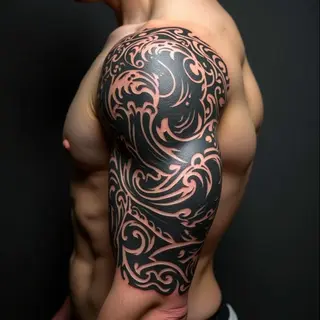
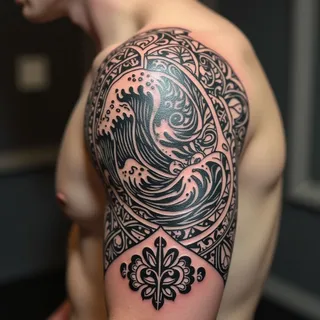
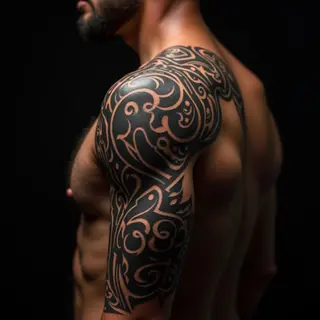
Polynesian work follows the muscles. A shoulder cap that wraps onto the chest and down the arm is the most common modern form; notice how the bands of pattern change direction at the elbow and collarbone.
 AI-generated
tribal · bodyPolynesian Tattoo Meanings & Symbols: A Comprehensive GuideShoulder and chest in one piece, with bands of spearheads and curling fill - the most visited Polynesian design on the site.
 AI-generated
tribal · armUnlocking the Stories: Polynesian Tattoos & Their MeaningsLarge curving shapes over the shoulder with dense fill between them.
 AI-generated
tribalUnlocking Ancient Wisdom: Polynesian Tattoo Symbols & MeaningsA wave form framed by geometric bands down the arm.
 AI-generated
tribal · armPowerful Polynesian Tattoo Designs for Guys: Meaning & InspirationBold black shapes on the shoulder, a lot of negative space - reads from a distance.
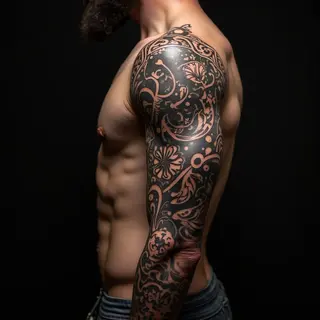 AI-generated
tribalDecoding the Meaning of Polynesian Tattoos: A Cultural GuideFull arm, the pattern tightening toward the wrist.
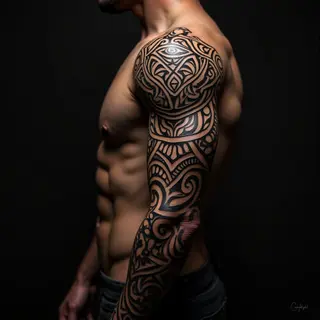 AI-generated
tribalUnveiling Polynesian Tattoo Meanings & Designs: A Legacy of Art and StorytellingShoulder to forearm with a vertical band along the side of the body.
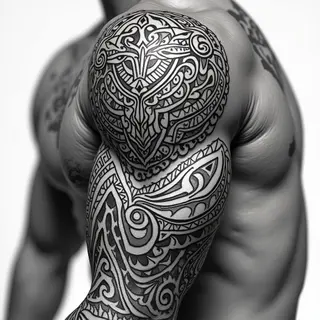 AI-generated
tribalUnveiling the Deep Meanings Behind Polynesian Tattoos
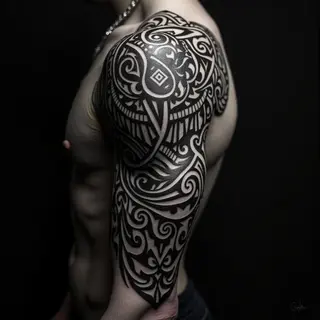 AI-generated
blackwork · bodyUnveiling the Darkness: Samoan Tattoo Meanings & Symbols – A Blackwork Perspective
 AI-generated
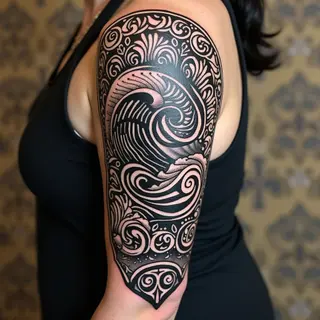
tribalUnderstanding Flash Tattoos: A Polynesian PerspectiveA half sleeve on a woman's arm, flowing shapes rather than hard geometry.
 AI-generated
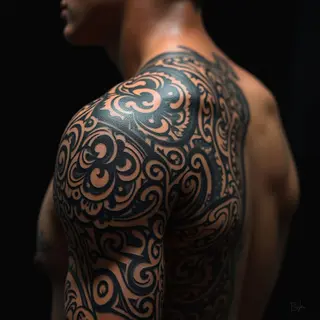
tribalHow to Get a Tattoo Designed: A Polynesian Guide
 AI-generated
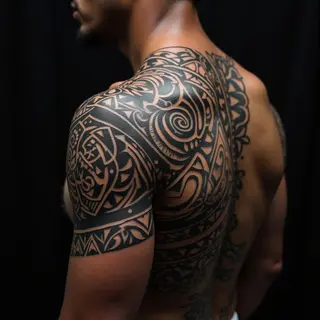
tribalUnlocking the Meanings of Geometric Shapes in Tattoos
IIIThe motifs and what they are usually taken to mean
There is no single dictionary, and meanings differ between islands. These are the readings you will meet most often:
- Shark teeth (niho mano): protection, strength and adaptability. Rows of small triangles, often as borders.
- Ocean and waves: life, change, the journey - and, for island peoples, the road between homes.
- Turtle (honu): long life, family and navigation; turtles return to the same beach to lay eggs.
- Spearheads: courage and the warrior; rows of them often read as determination.
- Human figures (enata, Marquesan): people - family, ancestors, sometimes defeated enemies - linked hand to hand.
- Sun: richness, leadership and new beginnings.
- Tiki: a semi-divine ancestor figure, worn for protection.
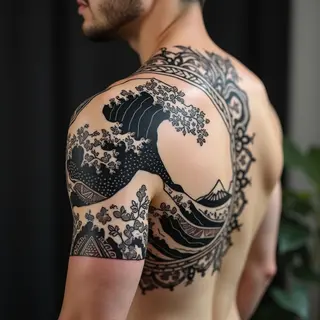
Ask your artist which tradition each motif comes from. A design that mixes Samoan bands with a Japanese wave and a Maori spiral may look good, but it says nothing in any of those languages.
IVSamoan-style backs and forearms
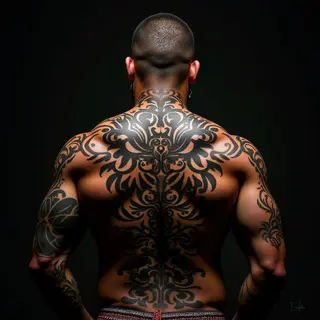
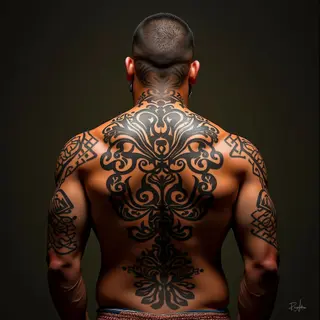
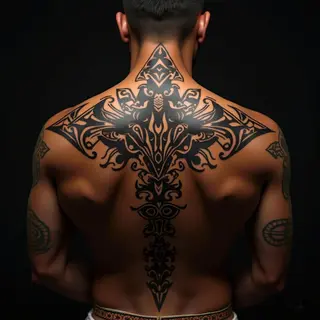
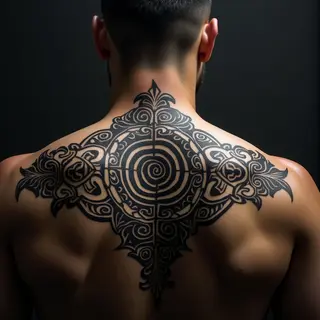
Samoan work is dense and architectural: thick horizontal bands, fine lines between them and large solid areas. Back pieces here follow the spine and spread across the shoulders.
 AI-generated
tribalSamoan Tattoo Meanings & Symbols: A Deep Dive into TraditionFull back in dense black work, symmetrical along the spine.
 AI-generated
tribal · bodySamoan Tattoo Designs & Meanings: A Cultural GuideA similar back layout with more open skin between the motifs.
 AI-generated
tribalUnderstanding Polynesian Tattoos: Meanings, Styles, & Cultural SignificanceUpper back and neck, the pattern fanning out from the spine.
 AI-generated
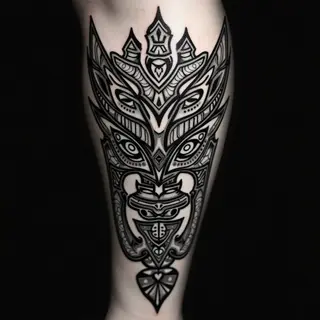
tribalHow to Design Your Own Authentic Polynesian TattooA centred medallion across the shoulder blades.
 AI-generated
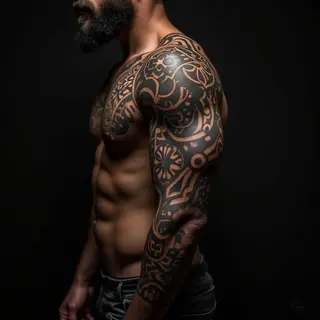
tribalUnraveling the Meaning Behind Samoan Tribal TattoosA mask-like figure on the forearm - a modern, Marquesan-flavoured take.
 AI-generated
tribal · armSamoan Tattoo Designs for Men: Meaning & Inspiration
VSmaller pieces: bands, wrists and family
 AI-generated
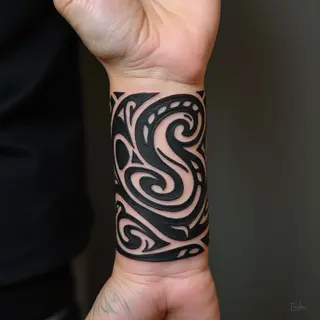
wristTattoo Designs for Male Wrist With Meaning: A Guide to Polynesian and Tribal StylesA wrist band of curls - the smallest way to wear the style.
 AI-generated
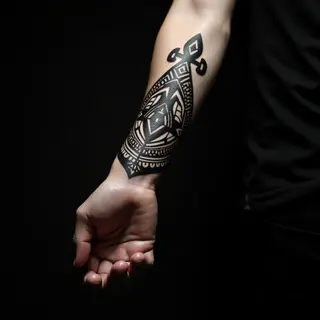
trash-polka · wristPolynesian Wrist Tattoos: Meanings & Trash Polka DesignsA narrow band on the inner wrist and forearm.
 AI-generated
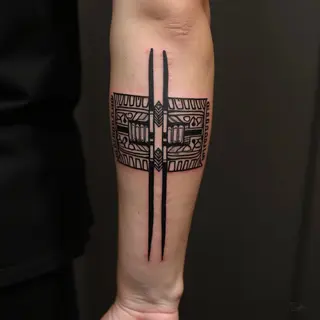
tribal · armUnderstanding the Meaning of Arm 2 Line TattoosTwo solid lines around the forearm with patterned bands between them.
 AI-generated
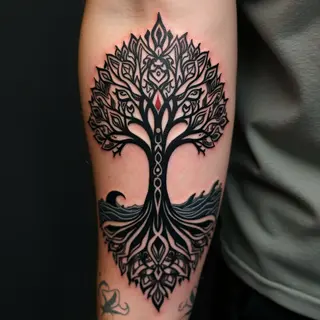
tribalTattoo Ideas Celebrating Family Bonds: A Polynesian PerspectiveA tree in Polynesian-style blackwork: family as roots and branches.
 AI-generated
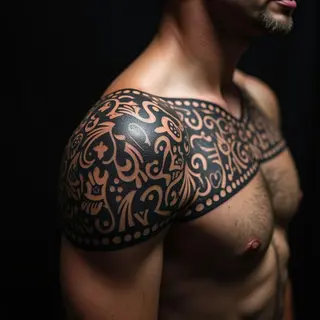
tribal · shoulderTattoo Ideas for Dad, Son & Daughter: Celebrating Family Bonds with Polynesian ArtA shoulder piece designed for a father, with space for the children's elements.
 AI-generated
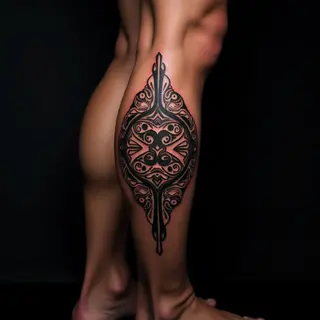
realism · calfPolynesian Calf Tattoos: Meanings & Realistic Designs
 AI-generated
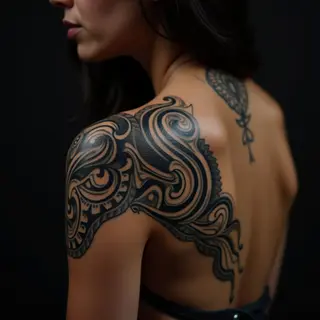
tribalWhat Do Waves Mean in Polynesian Tattoos?A Japanese-style wave set into a Polynesian shoulder piece - a fusion, not a traditional design.
 AI-generated
tribal · shoulderUnique Women Tattoo Ideas with Meaning: A Polynesian Perspective
VIWearing it with respect
Many Polynesian artists are glad to tattoo visitors and design Polynesian-inspired pieces for them. What causes offence is copying: taking a design that belongs to someone's family, or reproducing a traditional pe'a, malu or Maori face moko as decoration. The safest path is to work with an artist trained in the tradition - ideally a Polynesian artist - tell them your story, and let them build the design from it instead of bringing a picture from the internet.
VIIQuestions people ask
Can non-Polynesians get Polynesian tattoos?
Many people do, and many Polynesian artists welcome it. Choose a Polynesian-inspired design made for you, avoid traditional pieces that mark status or family (pe'a, malu, face moko), and work with an artist who knows the culture.
Do Polynesian tattoos have meanings?
Yes. Each motif has common readings, and a design made for you can be arranged to tell your story - family, journeys, losses. A copied design carries someone else's story.
What is the difference between Samoan, Maori and Hawaiian tattoos?
Samoan work is built from straight bands and dense geometry; Maori ta moko uses curving spirals (koru) and has its own sacred rules; Hawaiian kakau favours bold geometric bands and island motifs. Separate guides on this site cover Maori and Hawaiian designs.